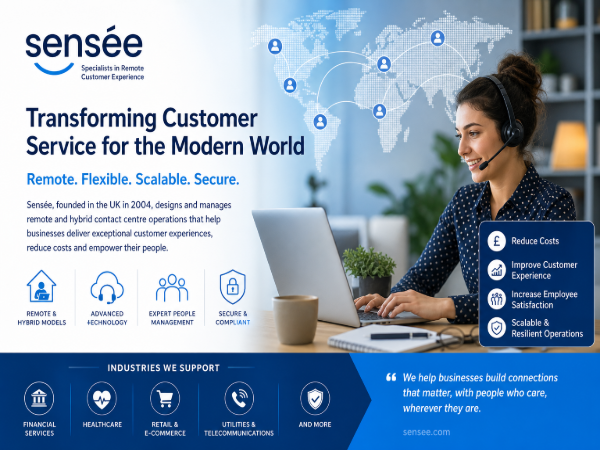
Sensée is a UK-based company founded in 2004 that specialises in designing and managing remote and hybrid contact centre operations for businesses. It enables organisations to deliver customer service through work-from-home and flexible staffing models supported by advanced workforce management technology. By combining digital platforms, operational expertise, and remote employee networks, Sensée helps companies improve customer experience, reduce operational costs, and increase employee satisfaction while maintaining scalable and secure service delivery across multiple industries.
Table of Contents
ToggleIntroduction to Sensée
Sensée is a pioneering UK-based organisation that has played a major role in reshaping how customer service operations are delivered in the modern business environment. Established in 2004, the company focuses on replacing traditional physical call centres with flexible, remote, and hybrid contact centre solutions.
Instead of relying on large office-based teams, Sensée enables businesses to build distributed customer service workforces that operate from home or hybrid environments. This model has become increasingly relevant due to advances in cloud computing, communication technologies, and changing workforce expectations.
The company’s core mission revolves around improving customer experience while also enhancing employee wellbeing and operational efficiency. Sensée achieves this by combining technology, people management, and process optimisation into a unified service offering.
The Evolution of Sensée
When Sensée was founded in 2004, most contact centres in the UK operated in large physical offices with hundreds or thousands of employees working in centralized locations. This traditional model often came with high operational costs, rigid working conditions, and limited flexibility for employees.
Sensée introduced a different approach by promoting remote working long before it became mainstream. At the time, the idea of running large-scale customer service operations from home was considered unusual and risky by many organisations.
However, the company demonstrated that with the right systems in place, remote contact centres could be just as efficient and even more effective than traditional setups. Over time, improvements in internet connectivity, cloud-based platforms, and secure communication tools allowed Sensée’s model to scale significantly.
Today, hybrid and remote working models are widely accepted across industries, and Sensée is recognised as one of the early innovators in this transformation.
Core Business Model of Sensée
Sensée operates on a business model that focuses on outsourcing and managing customer contact centre operations for client organisations. Instead of companies building and maintaining their own internal call centres, they partner with Sensée to deliver these services externally.
The model includes three key components:
Remote Workforce Management
Sensée recruits and manages customer service agents who work from home. These employees are fully trained, monitored, and supported through digital systems that ensure performance standards are maintained.
Technology Infrastructure
The company provides secure cloud-based platforms that enable communication between agents and customers. These systems include call routing, chat support, performance monitoring, and data security tools.
Operational Expertise
Sensée applies decades of experience in contact centre management to optimise workflows, improve response times, and ensure high-quality customer interactions.
Hybrid and Remote Contact Centres Explained
A hybrid contact centre combines both remote and office-based employees, while a fully remote contact centre operates entirely through home-based agents.
Sensée specialises in both models, allowing businesses to choose the structure that best fits their needs.
In a remote contact centre:
- Agents work from home using secure systems
- Supervisors monitor performance digitally
- Communication happens through cloud-based platforms
In a hybrid model:
- Some employees work from office locations
- Others work remotely
- Operations are integrated through shared systems
This flexibility allows companies to scale quickly and adapt to changing business demands.
Technology Behind Sensée’s Operations
Technology is the backbone of Sensée’s service delivery model. Without advanced systems, managing distributed teams would not be possible.
Key technological components include:
Cloud Communication Systems
These allow voice calls, emails, and chat messages to be routed to remote agents securely and efficiently.
Workforce Management Tools
These systems handle scheduling, attendance tracking, and workload distribution across teams.
Performance Monitoring
Managers can track metrics such as response times, customer satisfaction scores, and resolution rates in real time.
Security Infrastructure
Because sensitive customer data is often handled, strong encryption and compliance systems are essential to protect information.
Benefits of Sensée’s Model
Sensée’s approach provides benefits to both businesses and employees.
For Businesses
- Reduced operational costs compared to physical call centres
- Ability to scale teams up or down quickly
- Improved customer service flexibility
- Access to a wider talent pool across different regions
- Enhanced disaster recovery and business continuity
For Employees
- Flexible working environment
- Reduced commuting time and costs
- Better work-life balance
- Opportunities for remote employment
- Access to structured training and development
Industries Served by Sensée
Sensée works with a variety of industries that require strong customer service capabilities. These include:
Financial Services
Banks, insurance companies, and financial institutions rely on contact centres to handle customer inquiries, claims, and account support.
Healthcare
Healthcare providers use contact centre services for appointment scheduling, patient support, and information management.
Retail and E-commerce
Online and physical retailers depend on customer service teams to handle orders, returns, and product inquiries.
Utilities and Telecommunications
Energy providers and telecom companies require large-scale support systems for billing, technical issues, and service management.
Why Companies Choose Sensée
Businesses choose Sensée because it offers a combination of flexibility, efficiency, and expertise.
Traditional call centres often require high investment in infrastructure, office space, and staffing. Sensée removes many of these barriers by providing a ready-made remote workforce solution.
Companies also benefit from improved scalability. During peak seasons or high-demand periods, additional staff can be deployed quickly without physical expansion.
Another key advantage is resilience. Remote contact centres are less vulnerable to disruptions such as office closures or local emergencies.
Challenges of Remote Contact Centres
While Sensée’s model is highly effective, it also comes with challenges that must be carefully managed.
Communication Management
Coordinating remote teams requires strong communication systems to ensure consistency and alignment.
Performance Tracking
Managers must rely on digital tools rather than physical supervision, which requires accurate data systems.
Employee Engagement
Maintaining motivation and connection among remote workers can be more difficult compared to office environments.
Data Security
Handling sensitive customer data remotely requires strict compliance and security protocols.
Sensée addresses these challenges through structured processes, training programs, and advanced technology platforms.
The Role of Sensée in Modern Work Culture
Sensée has contributed significantly to the wider adoption of remote and hybrid working models in the UK. Long before remote work became common globally, the company demonstrated that distributed teams could operate efficiently at scale.
This approach has influenced how many organisations now think about workforce design. The COVID-19 pandemic further accelerated this shift, making remote work a standard practice in many industries.
Sensée’s model aligns with modern expectations of flexibility, digital transformation, and employee-centric workplace design.
Future of Sensée and Remote Contact Centres
The future of Sensée is closely tied to the continued evolution of remote working technologies and customer experience strategies.
Key trends shaping the future include:
Artificial Intelligence Integration
AI tools are increasingly being used to assist customer service agents, automate responses, and improve efficiency.
Automation of Routine Tasks
Chatbots and automated systems handle basic queries, allowing human agents to focus on complex issues.
Increased Hybrid Work Adoption
More companies are expected to adopt hybrid models combining remote and office-based teams.
Enhanced Data Analytics
Better analytics will help companies understand customer behaviour and improve service quality.
Sensée is positioned to benefit from these trends due to its established expertise in remote operations.
Conclusion
Sensée is a leading UK-based company that has transformed the way contact centre operations are designed and delivered. By introducing remote and hybrid working models, the company has helped businesses reduce costs, improve flexibility, and enhance customer service quality.
Its combination of technology, workforce management, and operational expertise makes it a key player in the modern customer experience industry. As remote work continues to evolve, Sensée is likely to remain an important contributor to the future of contact centre innovation.